

Why Getting 3 Contractor Bids Doesn't Work for Remodeling, and What to Do Instead
Why Getting 3 Contractor Bids Doesn’t Work for Home Remodeling—and What to Do Instead
When it’s time to remodel your kitchen, bathroom or build an addition, there is a better way to determine pricing than getting free bids.
We all do it. You want to buy a new TV, a dishwasher, or a set of tires—you shop around, compare prices, maybe read reviews, and go with the best deal. Makes perfect sense.
So it’s no surprise that many homeowners approach remodeling the same way: “Let’s get three bids for our kitchen remodel and go with the contractor with the best price.” Or maybe you know that the lowest price is often a sign of trouble, so you pick one of the others, thinking that the extra cost equals extra insurance that the project will turn out better.
But here’s the problem—remodeling your home isn’t an off-the-shelf product. You’re not buying something that already exists. You’re creating something custom from the ground up. And that changes everything.
The Myth of the “Apples to Apples” Comparison
In theory, competitive bidding sounds smart. In practice, it’s a mess. Why? Because at the time bids are collected, most remodeling plans are vague at best. There’s no detailed design, no specifications, no material selections—just rough ideas and wish lists. Even if you’re starting with a set of plans, there are likely hundreds of decisions regarding materials and methods that are left to the interpretation of the bidding party.
So what are bids, really? Guesses. Educated guesses, maybe—but guesses all the same.
The numbers you receive might be wildly different, but even that doesn’t really tell you much—you’re still in the dark about what’s driving those price differences. You won’t know which bidder has made grossly optimistic assumptions, or which one included allowances for unknowns that are very likely to come up.
Why a Low Bid Usually Isn’t
Here’s a hard truth: low bids often lead to higher costs in the end. That’s because the bidding process forces contractors to try to win jobs by coming in with a low price. While homeowners might view this as heathy competition that ensures they’ll get a good price, the system actually works against them. What often happens is that contractors who bid competitively to land a job have to make up for it later—through change orders, cut corners, or rushed work.
What started out looking like a deal can quickly become a headache. Projects go over budget, timelines slip, and relationships strain. And that’s not good for anyone.
There’s a Better Way
Instead of gathering bids based on guesswork, consider this: hire a reputable remodeling company to guide you through a proper pre-construction process.
Yes, it involves paying a fee up front—but what you get in return is real value. You get help clarifying your goals, developing a thoughtful design, making informed decisions about materials and systems, and—crucially—receiving a detailed, accurate cost analysis based on actual plans.
Not a ballpark. Not a best-case scenario. A true picture of what your project will cost, and what it will take to get it done right.
This approach saves time, avoids surprises, and lays the groundwork for a smoother, more successful remodel.
So before you send out bid requests and cross your fingers, ask yourself: Would I rather gamble with guesses, or invest in clarity and confidence from the start?
Because when it comes to remodeling your home—the place you live and love—guesswork just isn’t good enough.
Have questions about how a paid pre-construction process works? Reach out anytime. We’re happy to explain how it can save you time, money, and a whole lot of stress.
Whether you’re interested in an antique home renovation, luxury kitchen or bathroom remodel, addition, or even a structural repair, we can help. We are trusted local contractors specializing in high-end home remodeling.
1974 Magazine Feature and 2025 Follow Up Concord MA
Our client shared a magazine article with us that featured their home back in 1974. At that time, it was the personal residence of the original architect (and internationally known aquarium designer) Peter Chermayeff and his family. Interestingly, some years later, the house changed ownership and was turned into an art gallery. Our clients originally contacted us to take on the project of converting the art gallery back into a home, so they could move in and enjoy the setting as much as the original owners. (Extensive conservation measures were added in the decades since the original construction, which we followed carefully and diligently to ensure compliance with regulations for permitting.)
We completed that renovation a few years ago, and our clients love it! (Visit https://northriverbuilders.com/projects/nestled-in-nature/ for photos of the full remodel – kitchen, bathroom, living room, family room and bedroom.) A few weeks ago we were invited back for another project there, including painting the front door to match the color it was when it was in the magazine. We used that opportunity to take some photos of the magazine and the house to show a “Then and Now”. Here is a glimpse of some of the spaces:
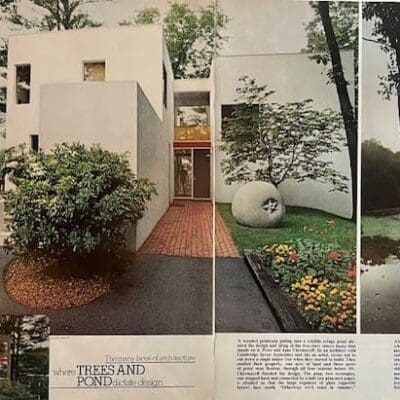
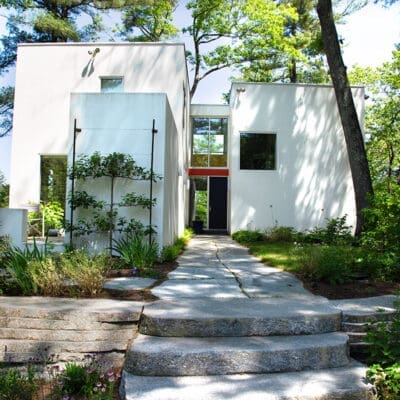
Some permitting requirements included removing invasive plant species and replacing with native plants and flowers. The owners also chose to replace brick and asphalt with natural stone.
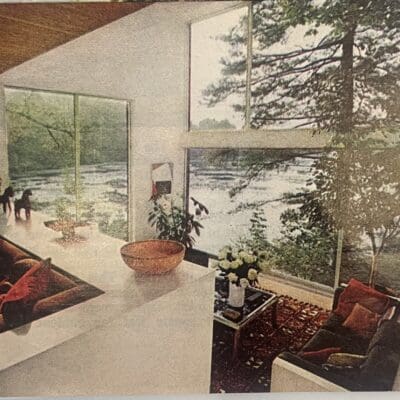
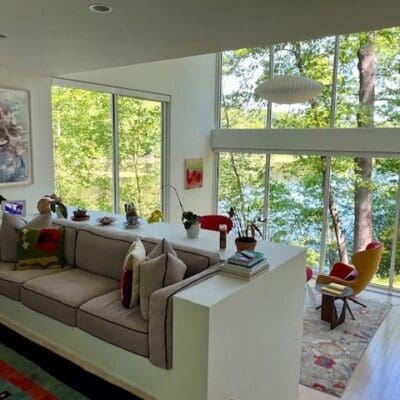
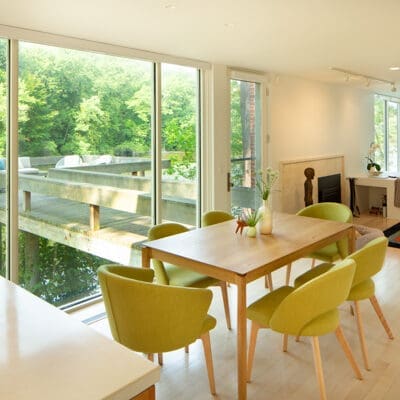
The living room still features the original built-in couch overlooking a seating area a few steps below with views of nature and water all around.
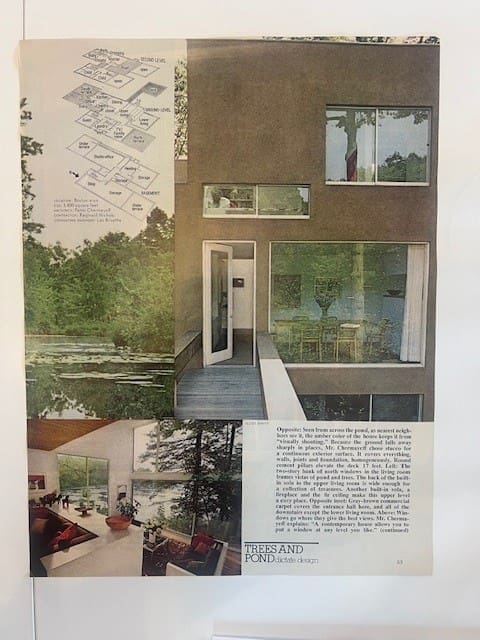
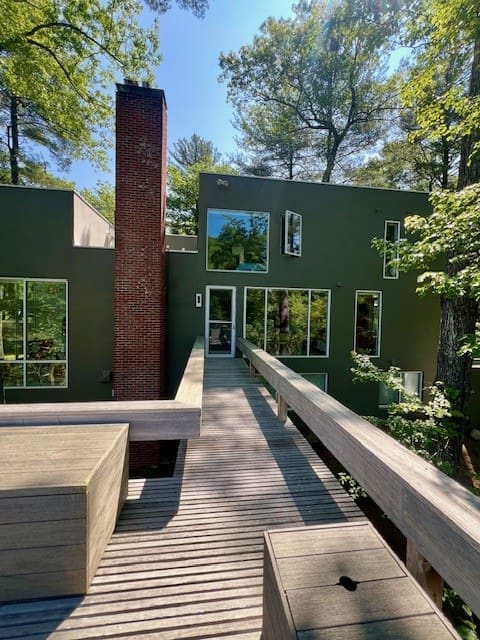
The house color is essentially the same as the original, but all the green from the trees reflects as house color in the current photo.
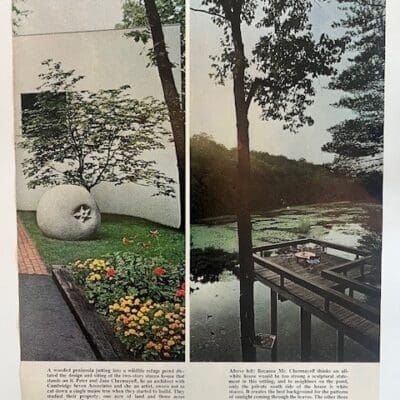
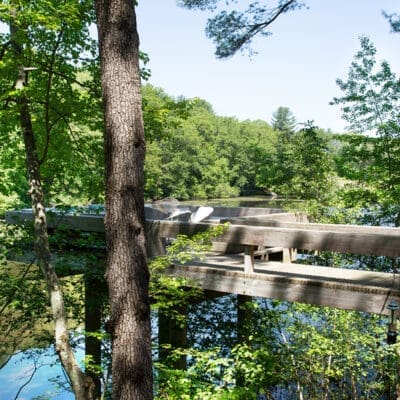
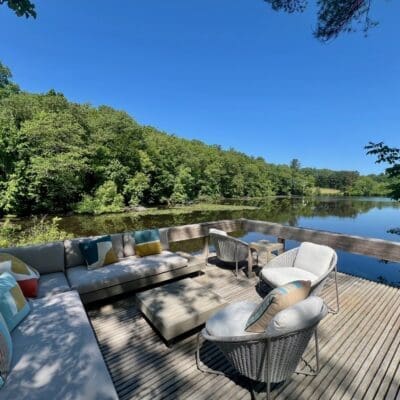
The deck, as shown in the magazine and currently, is the ultimate place for relaxation. Perched high above a pond surrounded by conservation land, it provides a fantastic view, and is high enough to keep the owners and their guests out of reach of the mosquitos below.
If you have a home that needs to be remodeled, or appropriately improved to match the original architectural style, North River Builders, Inc. has the experience you need. We enjoy working with all types of home styles in New England; mid-century modern, antique homes, classic colonials and contemporary, to name a few. Call us to learn how we can help with your home remodeling project.
Wetlands Compliance & Historic District Compliance for Contractors in MA
At North River Builders Inc, there are a few areas of expertise that set us apart from other reputable contractors and remodeling companies. Two of these areas are Wetlands Compliance & Historic District Compliance.
Our local geography has a mix of conditions, including antique properties in historic districts AND many wetlands and protected conservation areas. If your home is within either of these special areas, it’s imperative to hire a contractor who understands the complexities that go along with these special areas. Typically, additional steps are required for approvals and building permits; having a contractor who is already familiar with these essentials will save unnecessary frustration or last-minute surprises with your remodeling project.
In addition to extra demands from municipalities, the craftsmanship itself needs to be a particular caliber to complement the existing surroundings (& of course for wetlands, additional care needs to be put into material sourcing to be sure the product is safe for water & will hold up in wet conditions.)
With our headquarters in New England, we encounter both types of properties fairly often & can confidently guide you through all the processes needed for your project, whether you're remodeling your home or building new.

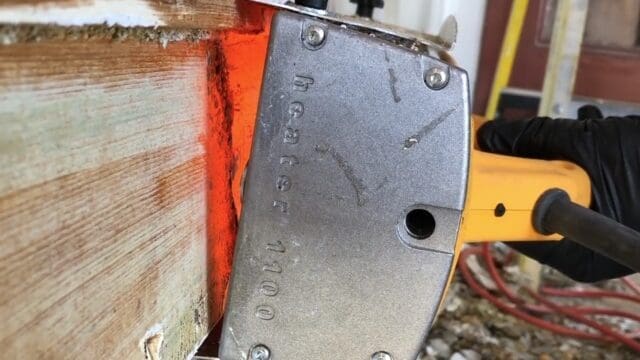
NRB YouTube Video - Infrared Paint Removal for Antique Homes
Here’s a link to one of our YouTube videos with Nile, our founder, explaining why infrared paint removal is the best method to remove paint from an antique house. He also shares his thoughts on why it makes sense to perform this labor-intensive procedure instead of simply replacing the old siding with new siding.
Renovating and Remodeling Antique homes is something that we do well. Antique and Historic homes present specific challenges that require a depth of knowledge and experience to deal with correctly. We would love to help you remodel your existing antique home or breathe new life into your newly-purchased antique home. Contact us to learn more!
Do you have a topic you would like us to cover on our next YouTube video? Let us know!
Office For Rent in Bedford Town Center
Rare opportunity to launch your new business (or relocate your existing one) in The Beech House, a high-visibility antique building in Bedford's Historic District! This antique gem in Town Center of Bedford, MA was renovated by North River Builders, and is home to NRB offices. The Beech House is also home to other local businesses, including a bookstore, a salon, and a wellness practitioner.
Unit 2D is available now for a 12 month lease (or longer)
- Renovated 2nd-floor unit in beautiful historic building
- Highly visible location in Bedford Town Center
- Perfect for professional office space, wellness practitioner, beauty services, etc.
- Current configuration is 2 private rooms, each with a sink and cabinets, and a large reception/display area. Can be returned to the open layout, see photos.
- Plenty of parking
- Private entrance
- Private bathroom in unit
- Unlimited use of outdoor spaces, including The Beech House Garden with benches, and two sitting porches furnished with rocking chairs
- $1975/month, all utilities & WIFI included
- Call for more information or a private tour, 978-341-0341. Take a virtual tour!
Fun fact: The Beech House was named for the 130+ year old beech tree on the north side of the property. It is one of the oldest, largest, and most beautiful trees in town.


#forlease #officespace #commercialrental
Honoring History While Building the Future
Honoring History While Building the Future: North River Builders, Inc.
As we approach the 250th anniversary of the American Revolution, it seems appropriate to take a moment to reflect on the historical roots of our community, and our role in preserving its legacy through craftsmanship and dedication to preserving buildings of historical value.
North River Builders, Inc. is proud to call Bedford, MA, home. Our office is located in Bedford’s Historic District, in our very own NRB-renovated antique home, located along the storied Freedom Trail between Concord & Lexington – the path of the Minutemen as they marched toward Concord on April 19, 1775, the day that changed the course of history with “the shot heard round the world.” (Fun fact: the Bedford Flag, the oldest flag known to exist in the US, was carried into battle that day by a Bedford Minuteman).
Our expertise in antique home remodeling, renovations, and structural repairs have earned the trust of architects and historic/antique homeowners. Recently we were fortunate enough to be called upon to lend our expertise in the renovation of two historically significant homes within the Minuteman National Park in Concord.
There is something truly special about restoring historic elements in a home with a story to tell. The design and build quality evident in so many New England homes is a testament to the craftsmanship of the past. We take great pride in honoring their intent and maintaining a home’s authenticity through careful planning and thoughtful improvements.
Our love for history extends beyond our projects. As we prepare to celebrate the 250th anniversary of the American Revolution alongside our neighbors in Concord and Lexington, we’re reminded of the significance of our location and the responsibility that comes with working in such a historically rich area. We’re not just builders and contractors, we are stewards of history, ensuring that homes and structures that stood during the birth of our nation continue to stand for generations to come.
Whether we are carefully renovating centuries-old beams or seamlessly integrating period-appropriate details into a full home remodel, our team approaches every project with respect for the past and an eye toward the future. We’re honored to contribute to the preservation of New England’s architectural heritage and look forward to celebrating this milestone anniversary with our community.
If you share our passion for history and craftsmanship, or if you have a home that needs expert care or remodeling (no matter its age or style), we would love to hear from you.


Will Repairs Destroy Your Antique Brickwork?
Modern Mortar Can Destroy Antique Brickwork
When it comes to preserving brickwork of an antique home, selecting the right mortar can mean the difference between success and irreversible disaster. When hiring a remodeling company or contractor for your antique home, it’s important to be sure they are experts in this field.
Antique brickwork is one example.
Most masonry professionals have a favorite off-the-shelf commercial mortar mix that they use for all of their repair and repointing work. What they may not realize is that modern mortar can spell disaster for bricks that are 100 years old or more. In this post, we explore why modern mortar is not suitable for repointing and repairing antique brickwork, and will provide recipes for mixing historically accurate custom mortar that can help save antique bricks from permanent damage.
What’s Wrong with Modern Mortar?
Nothing, really. Modern mortar, and modern bricks for that matter, are much more durable than their antique counterparts. The bricks and mortar sold today are much stronger and less permeable than the materials that were used in antique buildings. The key ingredient in modern mortar that gives it it’s strength is Portland cement, whereas historic mortars rely on much softer hydrated lime as the primary binding agent. While stronger mortar is a good thing in general, it actually creates problems for antique brickwork. When considering which mortar to use to repair or repoint bricks, the most important factor to consider is not strength or durability, but material compatibility. Antique bricks and mortar were made with softer, porous materials that hold more moisture and expand and contract more than modern bricks and mortar. When rock-hard modern mortar is paired with relatively soft antique bricks, it can lead to spalling, which can cause significant, irreversible damage over time.
What is Spalling?
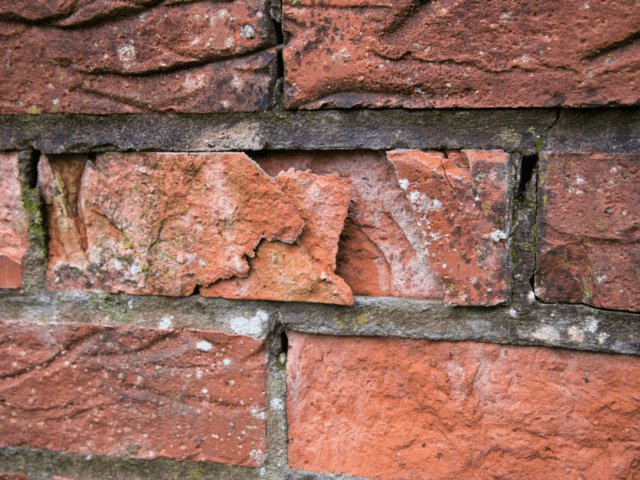
Spalling occurs when the surface of the brick begins to flake or crumble away, exposing the inner material. Spalling is most often the result of expansion and contraction due to changes in temperature and moisture in combination with incompatible materials. These expansion and contraction cycles can be absorbed when the bricks and mortar have compatible softness and expansion rates, but when Portland cement-based mortar is used for repointing antique brick, the rigid mortar restricts this natural expansion, eventually causing the brick face to crack, crumble, and ultimately fall away.
Freeze-Thaw Cycles: The Northern Culprit
Spalling can happen in any climate, but it is exacerbated by the freeze-thaw cycles of the North. When water seeps into the brick and then freezes, it expands, putting pressure on the surrounding mortar. This is where the rigidity of modern mortar can be a detriment, as it does not allow for the natural movement of the bricks. The result? Increased spalling and faster degradation of the brickwork.
Compatible Mortar for Antique Brickwork
Despite how common antique brickwork is in the USA, and especially in the Northeast where my company is based, it is still not easy to find pre-mixed lime-based antique mortar mix at commercial brick suppliers, and that’s a big part of the problem. At the very least, its an indicator that many in the masonry industry aren’t aware of the problem and/or what to do about it. With some advance planning, masonry pros can order premixed historically-compatible mortars. One online source is Limeworks.us. They sell historic lime-based mortars in varying coarseness and colors to match your project requirements.
Another approach is to custom mix mortar with ingredients sourced from a pro masonry supply source in your area. The key is to mix a mortar that matches the flexibility and breathability of the original material.
Here are some guidelines for creating a compatible mortar:
Basic Lime Mortar Recipe
Ingredients:
- 1 part hydrated lime (available from pro masonry suppliers. Note: Garden center lime WILL NOT WORK!)
- 2 parts sand (preferably a mix of sharp and fine sand)
- Water (to achieve the right consistency)
Instructions:
- Mix Dry Ingredients: In a clean, dry mixer or mixing container, combine the hydrated lime and sand.
- Add Water Gradually: Slowly add water while mixing until you reach a smooth, workable consistency. The mix should be moist but not runny.
- Let It Rest: Allow the mortar to rest for about 30 minutes. This helps with workability and ensures proper hydration.
- Test the Consistency: The mortar should stick together when squeezed but not ooze water. If it is too dry, add a bit more water.
Tips for fine-tuning the recipe:
- For very old, soft brick (late 1800s or earlier, you can increase the sand to lime ratio to 3 parts sand (up to 6 parts sand) to 1 part hydrated lime
- For masonry dating to the early 1900s, you could make your mix a little harder and more durable by introducing a small amount of Portland cement and changing the lime & sand ratios as follows: 1 part cement to 3 parts lime to 12 parts sand. *If in doubt, just stick with the softer sand & lime mortar mix
Note: lime-based mortar has a shorter working time but takes longer to fully cure than cement-based mortar
Conclusion
Repointing antique brickwork is an art that requires specific knowledge and selecting the right materials. By avoiding modern mortars and instead purchasing or mixing your own lime-based mortar, you can preserve the integrity and beauty of your antique brickwork for years to come.
Working with trusted, local experts with extensive experience in antique renovations will pay off in multiple ways, including avoiding issues like this. North River Builders Inc. has decades of experience working in New England homes, and especially on antique properties, which has given us a depth of knowledge that makes a difference in how we approach each individual project. Please give us a call to discuss your next project, we are your local experts in home renovations! 978-341-0341.
Feel free to share your experiences or questions in the comments below. Happy restoring!